
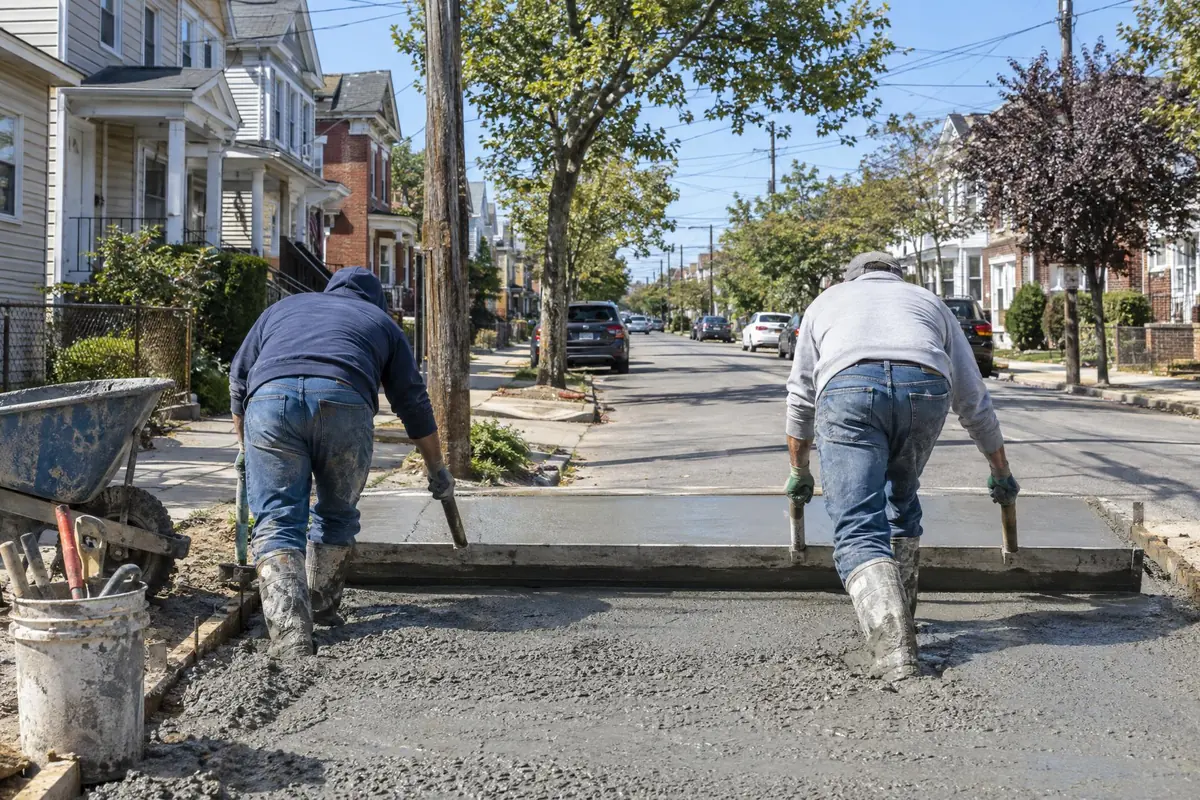
Two workers in rubber boots pull screed boards across a wet concrete slab on a street lined with older frame and brick houses

Concrete Block Wall Woodbridge New Jersey: Retaining Wall, Cinder Block Wall and Block Wall Cost

Dependable Concrete Block Wall and Retaining Wall Construction in Woodbridge, NJ and Middlesex County

Woodbridge Concrete builds the concrete block wall for homeowners across Woodbridge Township. A yard that slopes toward the house, a bank that is washing out or a boundary that needs a clean edge all call for a wall built to last. We handle the retaining wall, the cinder block wall that frames a garden or patio and the repair of a wall that has begun to lean, in Iselin, Colonia, Fords and Avenel.

Why homeowners choose us:

  • NJ-registered home improvement contractor
  • 20+ years pouring concrete across Middlesex County
  • Permits handled we file the township application and schedule the inspections
  • Free written estimates with every line of the price broken out

Our crew has logged 20+ years pouring concrete in Middlesex County, and a wall is a job where the footing under the block decides the outcome. The estimator who visits your yard also writes the estimate. Your free written estimate lists the footing, the block, the steel, the drainage and the cap on separate lines, and our office files what the Township needs.

Get a FREE Concrete Quote

What Concrete Block Wall Construction Involves in Woodbridge, NJ

A block wall is a stack of small parts that act as one, so it only works if the base, the steel and the water path are right. A garden wall, a boundary wall or a retaining wall includes these steps:

  • Layout sets the line, the height and the grade, so the wall runs straight and meets the slope where it should.
  • Trench and footing are dug and poured to depth, because the footing carries the whole wall.
  • Block courses are laid on a full bed of mortar, with each course checked for level and plumb.
  • Steel runs through the cores at set intervals and is grouted solid to tie the wall together.
  • Drainage of stone and pipe behind a retaining wall lets water leave instead of pushing on the block.
  • Backfill is placed in lifts and compacted so the soil does not settle against the wall.
  • A cap of concrete or cut stone sheds water off the top and finishes the wall clean.
  • Finish can be left as block, parged smooth or faced, depending on the look you want.

Signs You Need a New Block Wall in Woodbridge

When a Woodbridge Wall Needs Rebuilding

  • A lean toward the yard or the street shows soil pressure is winning, and a leaning wall rarely stops on its own.
  • Stair-step cracks in the mortar follow the joints and mean the footing has moved.
  • Bulging in the middle of a retaining wall points to water trapped behind the block.
  • White staining and wet patches show water working through the wall instead of draining below it.
  • A slope that is washing out into the yard or driveway needs a wall to hold it.

Why Block Walls Are Harder in Woodbridge Winters

Frost and the Footing

New Jersey footings are set to a frost depth of 36 inches, and a wall footing that sits above that line moves each time the ground freezes. A wall is heavy, so the movement shows up as cracks and a lean. In Woodbridge, zoning approval and a building permit cover most home improvements, and the required inspections include the footing. We book them by phone at (732) 602-6033 once the footing is formed and before it is covered.

Water Behind the Wall

Water is what pushes a retaining wall over. Developed land in the Township sits as little as 5 feet above sea level in places. Nearly a fifth of it falls within FEMA flood hazard areas, so the ground behind a wall can stay saturated. Stone and a drain pipe carry that water out at the bottom, and a wall without them is holding up a swamp. Effective drainage also slows freeze damage in the block.

Salt at the Base

A wall along a driveway or sidewalk is splashed with salted slush all winter. Salt attack scales the surface of block and concrete, and air-entrained mixes at 4,000 psi or higher hold up best. Calcium chloride is milder on masonry than rock salt, and ice melts with ammonium nitrate or sulfate act as fertilizers that attack it, so leave those out. A zoning review also applies when a wall sits near a property line, and the office checks the setbacks before a block is laid.

How Much Does a Concrete Block Wall Cost in Woodbridge, NJ?

Block wall cost depends on the wall, so a flat rate would mislead you. The height and length move the price. So do the depth of the footing, the steel, the drainage and the cap. A tall retaining wall costs far more per foot than a low garden wall. Tear-out of an old wall and access for the crew and the truck add to the total. On your written estimate, the footing, block, steel and drainage each carry their own price.

Our Concrete Block Wall Process in Woodbridge, NJ

4 steps take a wall from a marked line to a finished, drained structure.

1. Check the Line and the Grade

The estimator walks the line of the wall, measures the slope and looks at where water goes after a rain. We also note any fence, tree or utility marker near the line, because those change where the trench can go. A string and a level fix the height. We ask what the wall must hold back, because a garden edge and a retaining wall are different jobs. The free written estimate that follows lists each part, and our office files the permit paperwork.

2. Trench and Footing

The crew digs the trench to frost depth, sets the forms and pours the footing. The footing is the part that keeps the wall straight, so it gets inspected before it is covered. We let it set before any block goes on top of it, and the crew checks the trench bottom for firm, undisturbed ground before a single yard of concrete is placed.

3. Block, Steel and Fill

The crew lays block course by course on mortar, with the steel set in the cores and grouted. Level and plumb are checked on every course. Stone and drain pipe go in behind a retaining wall before the soil does. We do not build on frozen ground, and fresh mortar is protected from a hard freeze.

4. Finish, Cap and Backfill

The cap goes on, the face is finished and the soil is placed in lifts and compacted. Give the mortar and grout 7 days before heavy loads, and the full 28 days before anything leans on the wall. The site is cleaned and the drainage outlet is checked. The same crew pours a concrete patio and concrete footings for the rest of the yard.

Concrete Block Walls FAQs: Woodbridge, NJ

How much does a concrete block wall cost in Woodbridge, NJ?

The price follows the height, length, footing depth and drainage, so the estimate itemizes each one. Per foot, a tall retaining wall is a much bigger job than a low garden wall.

How deep does a block wall footing need to go?

New Jersey footings reach a frost depth of 36 inches. A footing shallower than that can be lifted by frozen ground and crack the wall above it.

What is the difference between a cinder block wall and a concrete block wall?

People use the names for the same masonry wall in everyday talk. We build with modern concrete block, filled with steel and grout where the wall needs strength.

Why is my retaining wall leaning?

Water behind the wall and a weak or shallow footing are the usual causes. Soil that stays wet pushes harder than dry soil.

Does a retaining wall need drainage?

A retaining wall does need it for the water behind the block. Stone and a pipe behind the block let water escape, and without them the wall carries the weight of wet soil.

Can a leaning block wall be repaired?

A wall that leans slightly with a sound footing may be braced and fixed. A wall that has moved at the footing needs to be taken down and rebuilt.

Can you build a wall in winter in Woodbridge?

Mortar should not be laid on frozen ground, and a job left unprotected in a hard freeze can fail within a day. We plan wall work around the forecast.

Woodbridge Concrete serves Woodbridge and Middlesex County.

Get a Free Concrete Block Walls Quote in Woodbridge, NJ

(732) 696-7898 Get a Free Quote